A Portrait of the Scientist as a Young Schmuck
There’s a text file on my computer in which I’ve written down some questions, the answers to which will firmly demarcate the line between science and engineering. Here are some of the questions I’ve set myself:
- Is there such a thing as ‘rocket science’?
- If a carrion crow retrieves food using a stick, is that engineering?
- Can a serendipitous discovery be scientific?
- Was the phase-contrast microscope invented or discovered?
- Was the Pantheon in Rome built by a scientifically advanced civilization?
While they exist on a spectrum, a lot of questions that are commonly perceived as scientific are, in fact, motivated by engineering problems at heart. Some examples: finding a cure for cancer (curing any disease, for that matter); understanding nitrogen fixation; understanding high-$T_c$ superconductivity; achieving quantum advantage. These are all research questions that are primarily interesting because they are expected to solve a problem.1 While fundamental research is needed to make progress on them, this is ultimately in service of an engineering question.
The romantic view of scientists as investigating the fundamental building blocks of nature without any other motive is supported by the development of quantum mechanics in the early twentieth century. Back then, scientists found that existing theories weren’t up to the task of explaining their experimental results, and so they had to come up with something else. Once the new theory had become established, science’s task became to confirm (or falsify), its predictions. The observation of the Higgs boson is a recent important discovery of this kind: it was a verification of one of the predictions of the Standard Model. In a way this addresses a research problem (‘How confident can we be in the Standard Model?’), but that’s a very different kind of problem compared to ‘How can I message my friend Barry without Eeyore breaking our encryption key using his quantum computer?’ What does science do in between paradigm shifts?
Contrasting the Higgs boson discovery, there was a rush to sequence the SARS-CoV-2 genome in early 2020, but absolutely no one did this because they ambled into the lab one day wondering how the gene expression for the virus’s spike protein worked. This was not blue-skies research – the goal was very much to use this knowledge to develop a COVID vaccine and to flatten the curve.
In order to get something to work you need to understand its underlying principles to some extent. What differentiates the scientist from the engineer is that the former focuses on the underlying principles, while the latter cares more about the getting-it-to-work part. These two modi operandi can coexist within one person – whenever I worked on a machine-learning project, I was loath to understand the intricacies of hyperparameter tuning, but I’d read enough about it to use sensible values. Conversely, when working through mechanical engineering textbooks I’ve sometimes been confused by the details they omitted such as the use of vector notation for torques. I learned about torque as a physics undergrad, but in my mechanics classes the focus was on understanding the underlying principles, not on calculating the bending moment of a beam. If you want to start from the concept of the bending moment, and use that to analyze the structural integrity of a building or bridge, it makes sense to dispense with some of the foundational frivolity; calculating outer products at every corner is inconvenient, after all.
I was mulling all of this over during a visit to Museum Boerhaave in Leiden, The Netherlands. The museum has a collection of historical scientific artifacts including some of the first microscopes built by Antoni van Leeuwenhoek. He’s famous for using them to observe bacteria, but his interest in magnifying optics stemmed from his background as a textile merchant who wanted to have a closer look at his fabrics. Perhaps his microbial observations were good PR, but they certainly did not help him run a better business. Yet, he specifically continued to sweat the small stuff. While everyone agrees he was adept at making tools, did he do this in the capacity of a scientist who wanted to discover stuff, or as an engineer who wanted to inspect his wares? How much does it matter, really?
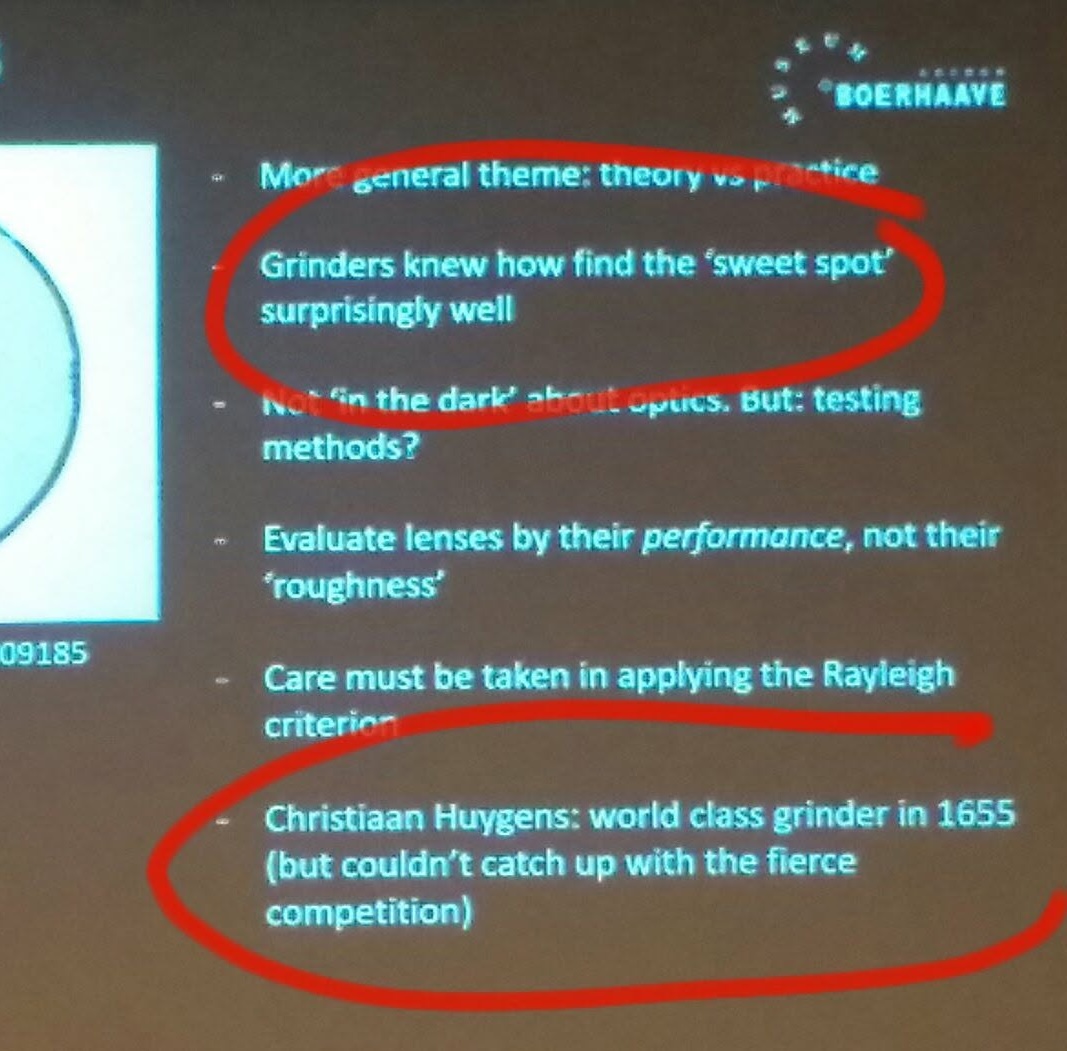
Aside: A curator from Boerhaave once gave a talk during the evening program of a conference I attended as a Ph.D. student. The central question was whether the Dutch or Italians made better optics, and the highlight of the talk was this delightfully innuendous slide:
The same museum displays a phase-contrast microscope, which was invented by Frits Zernike at the University of Groningen in the 1930’s. Normal microscopes create an image by illuminating a sample, and then forming an image on a sensor – be it a CCD or your retina. The image that gets formed depends on how much light the sample scatters (and in the case of a color image at which wavelengths it does so). A phase-contrast microscope instead forms image by interfering the scattered light with the illuminating beam, measuring the index of refraction instead. This was revolutionary, because it allowed Zernike to image objects that are mostly transparent – yet which do affect the field’s phase – including biological cells. To image a cell using a normal microscope, the cell has to be dyed which usually kills it. The phase-contrast microscope removes this requirement, enabling for instance the direct observation of cell division.
The kicker is that Zernike, who had a theoretical bent, was working on understanding spectral lines at the time. His lab used diffraction gratings to split out light by wavelength, but because the manufacturing process of the gratings was imperfect, the distance between the grooves was modulated periodically.2 The effect is that of combining two gratings, one with a much larger period, which hence results in faint ‘ghost lines’ on either side. At the time, there was a big debate about what was causing these ghost lines, and whether they were at all physical. Zernike wanted to understand them, and the entire reason that the idea for phase-contrast microscopy occurred to him is that his experiments on ghost lines gave him a much deeper insight in the role of phase in light fields and image formation [1,2].
These examples, where fundamental and applied science benefit from one another, are by no means to say that they’re one and the same, but something does get lost if a barrier is erected between them. For funding bodies it makes some sense to make this distinction, since the average taxpayer expects research results to be ‘useful;’ and the results that come from research on string theory are simply less likely to fit that bill than those from semicon research.
There’s no shortage of scientists who will tell you that there’s some return on investment to be found in fundamental research, too, because no matter how abstruse a research topic, there are always unexpected inventions that can be commercialized. Did you know we owe the dustbuster to NASA? What you also get is people prospecting for oil using portable gravitational-wave detectors, a turn of events so unexpected it has been awarded with several Dutch scientific prizes.
What is needlessly limiting is if researchers feel forced to label themselves as either doing fundamental or applied work. If solving problems gives you a sense of fulfillment, but learning about the underlying principles of your solution doesn’t, then by all means dedicate yourself to problem solving. It is equally possible, however, that someone enjoys solving practical problems using knowledge they obtained while dilly-dallying in the lab or library because they were simply curious about stuff.
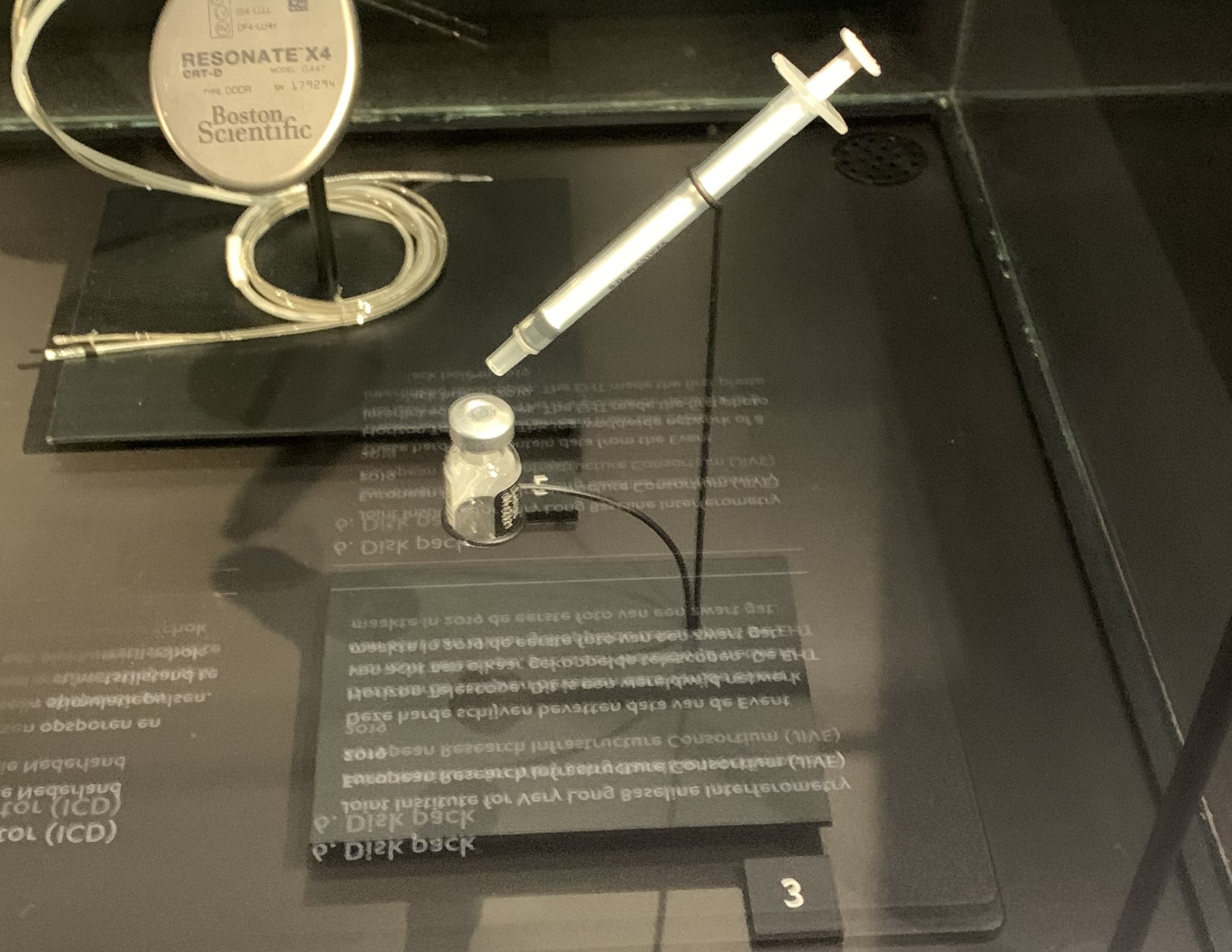
The displays towards the end of the permanent exhibition at Boerhaave investigate some of the big questions science is tackling right now. ‘Is there extaterrestrial life?’ for instance, or: ‘What is consciousness?’ The display on medical technologies contains a needleless syringe with an unremarkable vial. You need to read the sign to discover that these were used to administer the first COVID-vaccine in The Netherlands, roughly one year after the onset of the pandemic. While the vaccine was taken for granted almost immediately, it’s an example of the best science has to offer, being the product of a long history of people following their curiosity and using their insights for the betterment of mankind. It’s a reminder that true innovation is sometimes fast, but usually slow, stretching back centuries to Van Leeuwenhoek’s telescopes by way of Zernike’s insights in phase. I wish they would know how profoundly their work has benefited those who came after them.
References
[1] F. Zernike, How I Discovered Phase Contrast, Science 121 (1955).
[2] H.A. Ferwerda, Fritz Zernike – life and achievements, Optical Engineering 32 (1993).
Footnotes
-
To wit: people getting sick; the energy-inefficient Haber–Bosch process; cryogenic systems being bulky and costly to run; and data being encrypted. ↩
-
The device that was used to manufacture gratings, the Rowland ruling engine, used a turning screw to rule the grooves into a substrate, so whatever imperfection was in there was repeated every revolution. The ghost lines are sometimes also referred to as ‘Rowland ghosts.’ ↩